
Short answer: A 3 phase motor rotation tester is used to help identify phase sequence or motor rotation direction, not to prove that a circuit is dead or to replace safe-isolation practice. The documented product is the UNI-T UT261A, described as a non-contact three-phase AC phase-sequence and motor-rotation indicator with missing-phase indication. Before use, identify the circuit, follow site safety procedures, inspect the tester and confirm the product scope. It is not a temperature instrument: emissivity, surface reflectivity and infrared temperature accuracy are outside the documented function, and manufacturer does not specify them.
What a motor rotation tester can and cannot tell you
The product page positions the UNI-T UT261A as a non-contact three-phase AC phase-sequence and motor-rotation indicator. It also states that the model-specific display shows phase order, rotation direction and missing-phase conditions. That makes it relevant for checking whether a three-phase arrangement appears to have the expected sequence before equipment is operated, subject to the manufacturer's instructions and the site's electrical procedures.
The boundary matters. A phase-sequence indicator is not a voltage absence tester, insulation tester, current clamp, protective-device tester or proof that a motor is mechanically safe to start. It does not replace isolation, lock-off, proving the tester and proving dead where those steps are required. The product page also does not claim a result for a named motor, installation or control system.
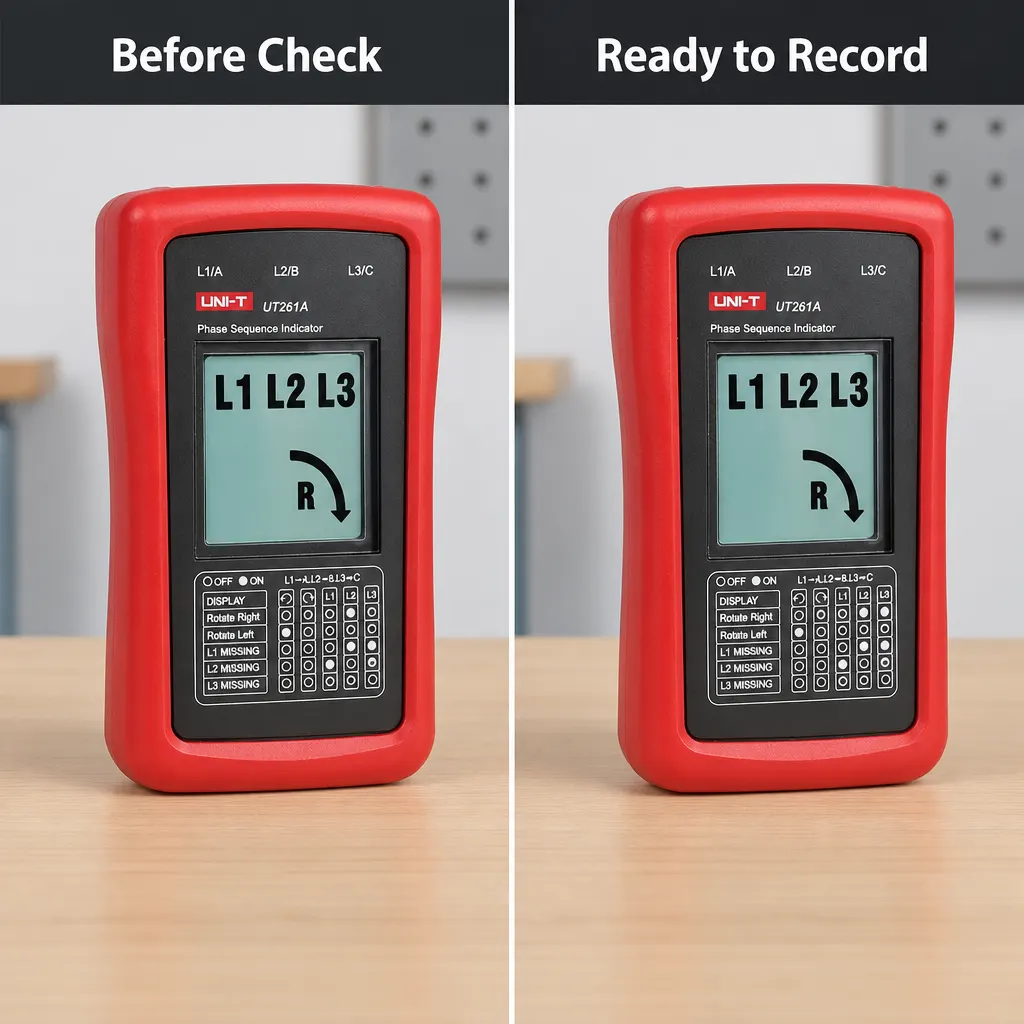
Check the documented product facts
The product page names the exact UNI-T UT261A model and describes non-contact three-phase AC phase-sequence indication, motor rotation direction indication and missing-phase conditions. Those are the facts to compare with the job. The page does not specify CAT category, measurement accuracy, operating range, environmental rating, battery life, certification or compatibility with a particular motor or distribution system.
Keep the comparison factual:
| Question | Documented on the product page | Still unknown |
|---|---|---|
| Function | Phase sequence, motor rotation direction and missing-phase indication | Whether it is suitable for a named installation or procedure |
| Connection style | Non-contact three-phase AC indication | The exact distance, field condition or conductor arrangement needed |
| Electrical limits | Manufacturer does not specify them on this product page | CAT category, accuracy, voltage range and protective rating |
| Temperature use | Not a documented function | Emissivity, surface limits, infrared range and temperature accuracy |
Make the pre-use check the first step
Before use, identify the circuit and the equipment, check that the work is authorised, and follow the responsible person's safe system of work. Inspect the tester for damage, contamination, loose parts or a depleted power source, and read the current manufacturer instructions. Keep hands, clothing and test equipment clear of moving machinery. Do not rely on a sequence result as permission to energise or start a motor.
Non-contact does not mean risk-free. Conductors can remain live, fields can be affected by arrangement and nearby equipment, and a missing-phase indication still needs investigation. If the installation, access or indication is outside the documented method, stop and escalate. For temperature work, use an actual infrared thermometer and check its emissivity and surface assumptions; this UT261A page does not specify those readings.
- Identify the exact three-phase circuit, equipment and work boundary before approaching it.
- Follow the site's isolation and proving procedure; do not treat the tester as a dead-circuit proof.
- Inspect the UT261A, check its condition and confirm the current instructions and power state.
- Apply the documented indication method without moving machinery or bypassing guards.
- Record an unexpected or missing-phase result and investigate before any start or reconnection.
Readings, surfaces and temperature limits
The phrase non-contact can be misleading because it does not make this a non-contact thermometer. Emissivity is an infrared surface property used by thermal instruments; surface finish, reflections and viewing conditions can affect infrared readings. None of that is a documented UT261A function here. Manufacturer does not specify emissivity adjustment, surface-material limits, temperature range or temperature accuracy, so this product should not be selected for a temperature reading.
For the electrical task, the same restraint applies to phase indications. The page does not specify a numeric accuracy, field-strength threshold, conductor spacing, CAT category, certification, service life or named compatibility. A result should be interpreted within the manufacturer's instructions and the site's electrical controls. If those details are mandatory for the work, obtain the current documentation or choose an instrument whose published specification matches it.
Related guides and product details
Use the UT261A as the documented phase-sequence and motor-rotation indicator it is presented as. Confirm the electrical method and safety controls before relying on any indication. Read Phase Order Tester for Electricians: Checks Before Buying for related guidance. Read Phase Rotation Tester UK: A Practical Pre-Use Buying Check for related guidance. Review the documented specification on the UNI-T UT261A Non-Contact Three-Phase Sequence and Motor Rotation Indicator product page before ordering.
Sources and safety context
- Supports the exact UT261A identity, non-contact phase-sequence function, motor-rotation indication and missing-phase description. Three-Phase Sequence Indicator product page.
- Provides manufacturer context for the UT261 series; use the current manual for operating details not stated on the retailer page. UNI-T UT261 Series official product information.
- Supports using appropriate electrical safety controls and competent procedures around electrical work. Electrical safety at work.