
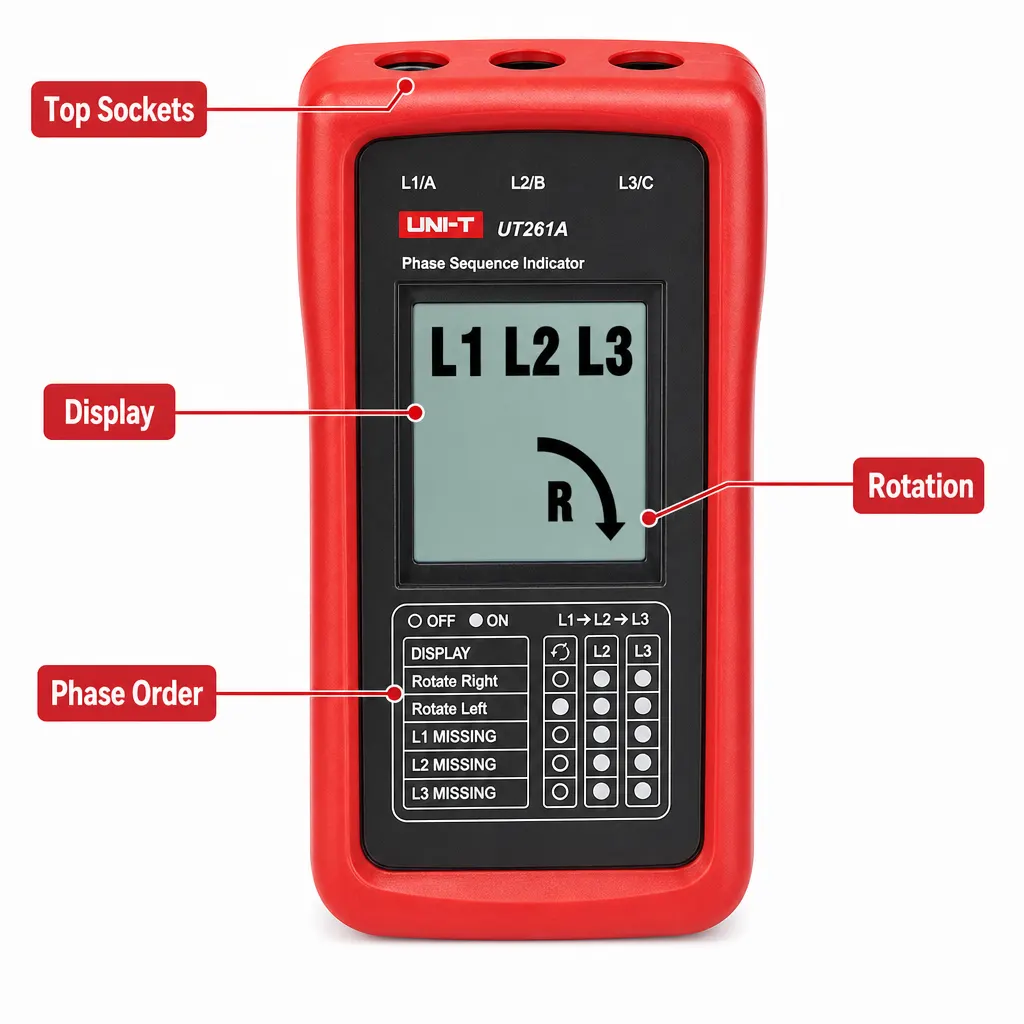
Short answer: A phase rotation tester in the UK should be chosen from the actual three-phase task, the site's safety controls and the instrument's published limits. The listed product is the UNI-T UT261A, described as a non-contact three-phase AC phase-sequence and motor-rotation indicator with missing-phase indication. Before buying, confirm that this is the function required, inspect the proposed work area and check the current instructions. The page does not specify CAT category, accuracy, compatibility or temperature measurement. Emissivity, reflective surfaces and infrared reading limits therefore belong to a separate thermometer decision.
Start with the phase-rotation task
A phase rotation check is about the order or direction indicated by a three-phase arrangement. The product page presents the UNI-T UT261A for non-contact three-phase AC phase-sequence indication, motor rotation direction indication and missing-phase conditions. That is the right starting point for a UK buyer: define which of those outcomes the job needs and whether the current procedure accepts this type of indication.
Do not use the phrase non-contact as a shortcut for no risk. The instrument is not described as a dead-circuit proof, a voltage tester, a current meter, a motor-safety check or a complete commissioning instrument. It cannot decide whether guards, isolation, earthing or the wider installation are satisfactory.
Check the listing against the work specification
The page provides a model identity and a short function description. It does not publish a numeric accuracy, CAT category, voltage or frequency range, field threshold, conductor spacing, environmental protection, certification, battery endurance or compatibility with a named motor, board or drive. Manufacturer does not specify those details on the product page, so they remain buying questions.
A simple UK comparison keeps the decision grounded:
| Requirement | What is stated | What to verify before relying on it |
|---|---|---|
| Phase task | Sequence, rotation direction and missing-phase indication | The indication meets the job's method statement |
| Contact method | Non-contact three-phase AC indication | Actual conductor layout, access and instruction-defined conditions |
| Safety limit | No CAT category is stated on the page | Safe isolation, PPE, CAT category and site controls |
| Reading limit | No numeric accuracy is stated | Required accuracy, threshold or repeatability |
| Temperature | No thermal measurement is stated | A separate thermometer with suitable emissivity and surface guidance |
Inspect the work area before relying on an indication
Identify the circuit and motor, define the work boundary and confirm who is responsible for isolation and energisation. Inspect the instrument for damage, contamination and a usable power state, then read the current manufacturer instructions. Keep moving machinery guarded and do not place a tester or person where a start could create harm. A surprising indication should trigger a pause and investigation.
Record the conditions that matter to the procedure: circuit identity, equipment state, expected sequence and result. If the access, conductor arrangement or installation falls outside the documented method, seek a competent second check. A phase indication is one piece of information; it is not an approval to start the motor or a substitute for proving the wider system.
- Write down the circuit, motor and expected phase-rotation outcome before approaching the equipment.
- Apply the site's isolation, lock-off and proving controls as required by the responsible person.
- Inspect the UT261A and confirm the current operating instructions and power condition.
- Make the non-contact indication check without bypassing guards or treating it as a dead-circuit proof.
- Record and escalate an unexpected result before energising, commissioning or reconnecting.
Keep temperature and surface claims separate
An infrared thermometer needs a different set of checks: emissivity, surface finish, reflections, viewing geometry and the instrument's stated temperature range and accuracy. The UT261A product page does not describe a temperature sensor or a thermal reading. Manufacturer does not specify emissivity adjustment, surface limits or infrared accuracy, so this tester should not be bought or cited for non-contact temperature measurement.
The same discipline applies to electrical readings. The page does not specify CAT category, accuracy, service life, certification or compatibility with a named installation. When a UK job requires one of those values, confirm it in the current manufacturer documentation or choose a tool whose published specification matches. Do not turn an unknown into a reassuring number.
Related guides and product details
For UK phase-sequence work, compare the UT261A with the actual method statement and safety controls. Keep temperature, isolation and other electrical measurements on tools specified for those jobs. Read 3 Phase Motor Rotation Tester: What to Check Before Use for related guidance. Read Phase Order Tester for Electricians: Checks Before Buying for related guidance. Review the documented specification on the UNI-T UT261A Non-Contact Three-Phase Sequence and Motor Rotation Indicator product page before ordering.
Sources and safety context
- Supports the UT261A identity and the stated non-contact phase-sequence, motor-rotation and missing-phase functions. Three-Phase Sequence Indicator product page.
- Provides manufacturer context and a route to current operating documentation. UNI-T UT261 Series official product information.
- Supports appropriate controls and competent procedures for work around electrical systems. Electrical safety at work.