
Short answer: A phase order tester for electricians is useful only when its documented indication matches the electrical task and the user already has a safe working procedure. The product on this page is the UNI-T UT261A, described as a non-contact three-phase AC phase-sequence indicator with motor rotation direction and missing-phase indication. That does not make it a universal electrical tester. Check circuit identity, access, equipment condition and the current manufacturer instructions first. The product page does not specify CAT category, accuracy or temperature measurement, so emissivity, reflective surfaces and infrared reading limits are outside this tool's stated scope.
Define the electrical job first
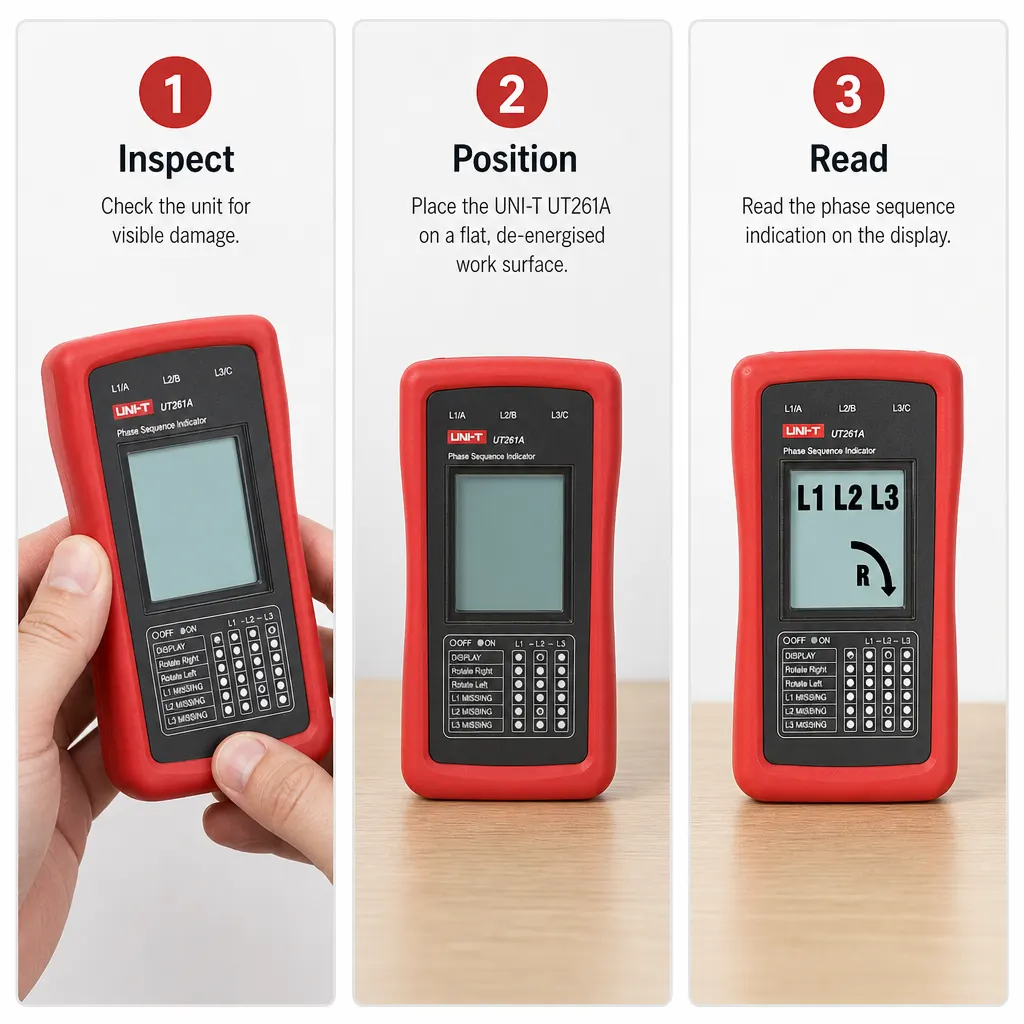
Electricians may use phase-order information when commissioning or checking three-phase equipment, but the correct tool depends on the procedure and installation. The UT261A product page describes non-contact three-phase AC phase-sequence indication, motor rotation direction indication and missing-phase conditions. Start by writing down what must be established: sequence, rotation direction, a missing phase, or something else entirely.
Do not stretch that description into a safety claim. The tester is not presented as proof of dead, a substitute for lock-off, a current measurement instrument, an insulation tester or a protective-device test. It cannot confirm that a motor is safe to start, that guards are fitted or that a control circuit is wired correctly in every respect.
Separate confirmed facts from unknowns
The exact model name is a useful identity check when comparing offers. The retailer page identifies the UT261A and the three documented indication functions. It does not specify a CAT category, numeric accuracy, voltage or frequency range, conductor spacing, environmental rating, certification, battery life or compatibility with a particular board, drive or motor. Manufacturer does not specify those values on the available product page.
Use this table when checking an offer or a site requirement:
| Buying check | Confirmed or stated | Required verification |
|---|---|---|
| Model | UNI-T UT261A is the listed model | Delivered item and current manufacturer documentation |
| Indication | Phase order, motor rotation direction and missing phase are described | Whether those indications meet the site's commissioning procedure |
| Safety | Non-contact is stated | Isolation method, CAT category and protective controls |
| Measurement | No numeric accuracy is stated | Any required accuracy, threshold or electrical range |
| Temperature | No temperature function is stated | Use a specified infrared instrument for temperature work |
Use a disciplined pre-use sequence
Before use, identify the circuit, motor and conductors, confirm that the task is authorised, and follow the site's safe system of work. Inspect the tester for damage or contamination and confirm its operating condition from the current instructions. Keep clear of rotating equipment and do not remove guards or bypass isolation to obtain a reading. If the installation is unfamiliar or the result is unexpected, stop and escalate.
A non-contact indication can still be affected by the physical arrangement and surrounding electrical environment. Treat missing-phase or rotation information as a result to investigate within the documented method, not as permission to energise. If the required job is actually voltage, current, insulation, temperature or compliance testing, choose the instrument specified for that measurement.
- Define whether the job is phase order, motor rotation or missing-phase indication.
- Identify the exact circuit and apply the responsible person's isolation and access controls.
- Inspect the tester and confirm the current manufacturer instructions before use.
- Make the indication check without treating non-contact operation as proof of a safe circuit.
- Document unexpected results and obtain a second check or competent assessment before energising.
Do not borrow limits from another instrument
The product page does not specify CAT category, accuracy, service life, certification, voltage range, field threshold or named compatibility. Those are not safe values to borrow from another UNI-T instrument or from a similar-looking tester. If a site specification requires one of them, manufacturer does not specify it on this page; confirm it in the current manual or choose a product with the requirement published.
The same rule applies to non-contact temperature language. An electrician may also need to inspect heat, but this phase-order tester is not documented as an infrared thermometer. Emissivity, surface finish, reflections and temperature-reading accuracy therefore sit outside the product scope. Keep a thermal measurement task separate from a phase-order task.
Related guides and product details
Buy the UT261A only when the documented phase-order or motor-rotation indication fits the actual procedure. Keep isolation, measurement and temperature tasks on their own specified instruments. Read Phase Rotation Tester UK: A Practical Pre-Use Buying Check for related guidance. Read 3 Phase Motor Rotation Tester: What to Check Before Use for related guidance. Review the documented specification on the UNI-T UT261A Non-Contact Three-Phase Sequence and Motor Rotation Indicator product page before ordering.
Sources and safety context
- Supports the exact model and the stated phase-sequence, motor-rotation and missing-phase functions. Three-Phase Sequence Indicator product page.
- Provides manufacturer context for the UT261 series and points buyers to current documentation. UNI-T UT261 Series official product information.
- Supports competent electrical working practices and the need for appropriate controls. Electrical safety at work.